

Can Longspan Racking Be Reconfigured After Installation? What Most Suppliers Don’t Tell You
Longspan racking is widely used in Malaysia warehouses because it is marketed as flexible, modular, and adjustable. Many buyers assume that once installed, the system can easily adapt to future storage changes.
But in real warehouse operations, things are more complex.
Yes, longspan racking can be reconfigured after installation, but the level of flexibility depends on design, load conditions, and installation quality. In some cases, adjustments are simple. In others, they require partial dismantling, downtime, or even system upgrades.
This article explains what is realistically possible and what many suppliers do not clearly highlight during sales.
What “Reconfigurable” Actually Means
Longspan racking is made from modular components:
- Upright frames (vertical structure)
- Beams (horizontal load support)
- Shelf panels (steel, plywood, or fibreboard)
Because of this design, you can:
- Adjust shelf height
- Add or remove beam levels
- Extend rack rows
- Modify layout arrangements
However, reconfigurable does not mean unlimited flexibility without consequences.
The Truth: Yes, But Not Always Simple
In theory, longspan racking is adjustable.
In practice, reconfiguration depends on:
- How the system was originally designed
- Load capacity requirements
- Warehouse layout constraints
- Safety compliance factors
- Component compatibility
So while changes are possible, they are not always:
- Fast
- Cheap
- Or disruption free
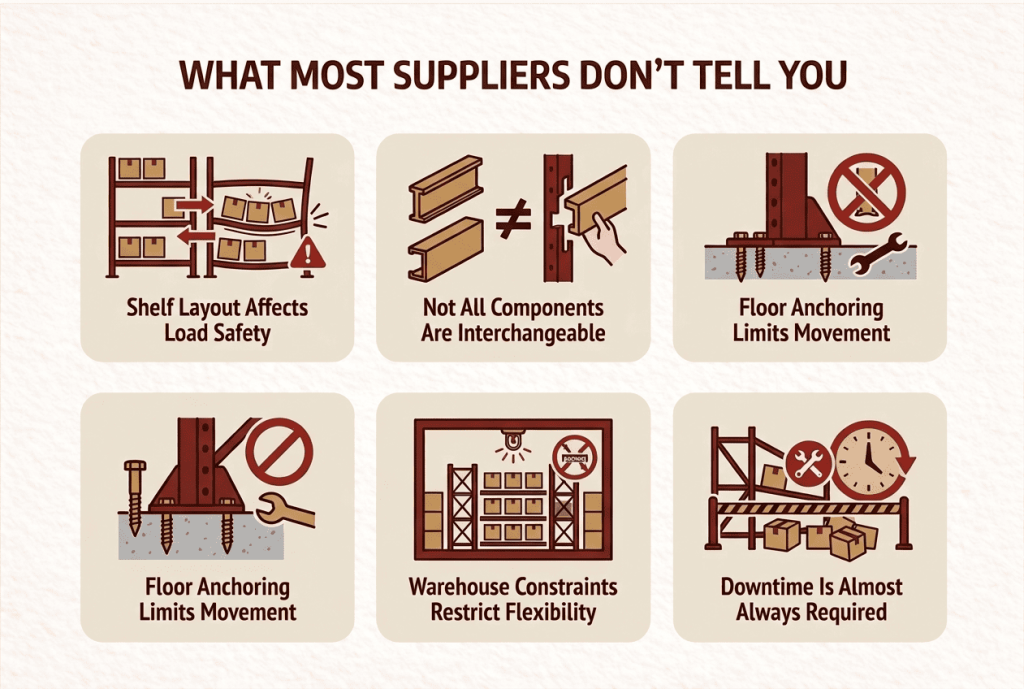
What Most Suppliers Don’t Tell You
1. Changing Shelf Layout Affects Load Safety
One of the most overlooked facts is that adjusting shelf height or spacing changes load behaviour.
Even small changes can affect:
- Weight distribution
- Beam deflection
- Upright stability
If changes are made without proper load calculation, it may lead to:
- Beam bending
- Structural stress
- Safety risks over time
This is why “just move the shelves up or down” is not always a safe assumption.
2. Not All Components Are Fully Interchangeable
Many buyers assume all longspan racking in Malaysia parts are universal.
In reality:
- Different suppliers use different beam profiles
- Load ratings vary between systems
- Connection designs may differ slightly
This means reconfiguration may require:
- Additional components
- Partial replacement of parts
- Supplier specific compatibility checks
3. Floor Anchoring Limits Easy Movement
Most warehouse racking systems are:
- Bolted to concrete floors
- Positioned based on forklift routes
- Designed for load zoning
So if you want to change layout, you may need to:
- Remove anchoring bolts
- Redrill floor positions
- Temporarily stop operations in that area
This makes reconfiguration more like a controlled reinstallation, not a simple adjustment.
4. Warehouse Constraints Often Restrict Flexibility
Even if the racking is adjustable, the warehouse itself may limit changes:
- Ceiling height restrictions
- Fire sprinkler clearance
- Aisle width for forklifts
- Loading and unloading flow
So a simple adjustment in shelving height can trigger a full layout rethink.
5. Downtime Is Almost Always Required
Suppliers often highlight flexibility, but not the operational disruption involved.
Reconfiguration usually requires:
- Removing stored goods
- Dismantling sections
- Reassembling racks
- Safety checks before reuse
For active warehouses, this downtime can directly affect productivity and operations.
When Reconfiguration Works Smoothly
Longspan racking is easier to modify when:
- The system was properly engineered from the start
- Standardised components are used
- Load capacity has safety margin and is not fully maxed out
- Layout was designed with future changes in mind
- The same supplier system is used throughout
When Reconfiguration Becomes Difficult
You will face challenges when:
- Mixed racking systems are used
- The system is overloaded close to maximum capacity
- Original design was not engineered properly
- Warehouse layout was not planned for future changes
- Heavy duty upgrades are required after installation
How to Ensure Real Flexibility in Your Racking System
If long term adaptability matters, here are best practices:
✔ Design with future growth in mind
Do not build only for current storage needs.
✔ Avoid maximum load usage from day one
Leave engineering safety margin.
✔ Standardise your racking system
Stick to one compatible system throughout the warehouse.
✔ Plan aisle spacing early
Forklift movement affects future layout flexibility.
✔ Work with experienced warehouse racking specialists
Not just installers, but engineers who understand layout planning.
Need a Flexible Longspan Racking System for Your Warehouse?
Not all racking systems are easy to modify later. The right setup from the start helps you avoid extra cost, downtime, and safety issues.
Get expert advice on longspan racking solutions in Malaysia tailored to your storage needs and future expansion.
Contact us today to plan a safer and more flexible warehouse storage system.
Conclusion
Yes, longspan racking in Malaysia can be reconfigured after installation, but it is not as simple as most people assume. While the system is modular and allows adjustments like changing shelf heights or expanding sections, every modification still needs to consider load limits, structural stability, and compatibility between components.
In practice, reconfiguration depends heavily on how the system was originally designed and how much flexibility was planned from the start. If it is properly engineered, changes can be done smoothly, but if not, adjustments may involve downtime, additional costs, and even partial rebuilding of the racking system.
Frequently Asked Questions (FAQs)
Can longspan racking be reconfigured after installation?
Yes, longspan racking can be reconfigured, but it depends on the original design, load capacity, and system compatibility.
Do I need to empty the racks before reconfiguring them?
In most cases, yes. The racks should be unloaded first to ensure safety during adjustments or dismantling work.
Is it easy to change the shelf height in longspan racking?
Yes, shelf height adjustment is one of the simplest forms of reconfiguration, as long as it stays within safe load limits.
Will reconfiguring longspan racking affect its safety?
It can, especially if load distribution or structural setup is changed without proper assessment or guidance.
Is reconfiguration cheaper than buying new racking?
Minor adjustments are usually cheaper, but major layout changes or upgrades can sometimes approach the cost of partial replacement.